


During the United Nations Climate Change Conference of 2021, several leaders and delegates were criticised online because they travelled to the summit in private jets. The irony was not lost, as the summit was intended to discuss changes that can be made to tackle climate change. Carbon emissions from air travel are notably one of the major contributors to global warming.
However, the truth is that more and more people are flying private these days. According to aviation data analysis company WingX, 2021 marked the busiest year on record for global business jet activity, with around 3.3 million such flights around the world. This number will indubitably increase manifold in 2023 as travel restrictions around the globe come to an end.
A recent survey by Private Jet Card Comparisons also showed that 51 percent of its subscribers plan to fly private more this year because of the convenience and enhanced connectivity, in stark comparison to poor airline service.
Despite all the perks of flying private, the surge in private jet flights simply translates to more carbon emissions. A study by the European clean transport campaign group Transport and Environment reveals that private jets are five to 14 times more polluting than commercial airlines on a per-passenger basis.
Today’s discerning travellers are expressing unprecedented concerns about carbon footprint by air travel. Last year, the International Air Transport Association (IATA) approved a resolution for the global air transport industry to achieve net-zero carbon emissions by 2050, which will align with the goal of the Paris Agreement to limit global warming to 1.5 degrees Celsius.
To realise this, joint efforts of different parties are indispensable, including the use of sustainable aviation fuel (SAF), application of radical new technologies, enhancement of flight efficiencies through infrastructure and operations, as well as offsetting and carbon capture. Private jet companies are also doing what they can to make private aviation more sustainable.
Using sustainable aviation fuel (SAF)
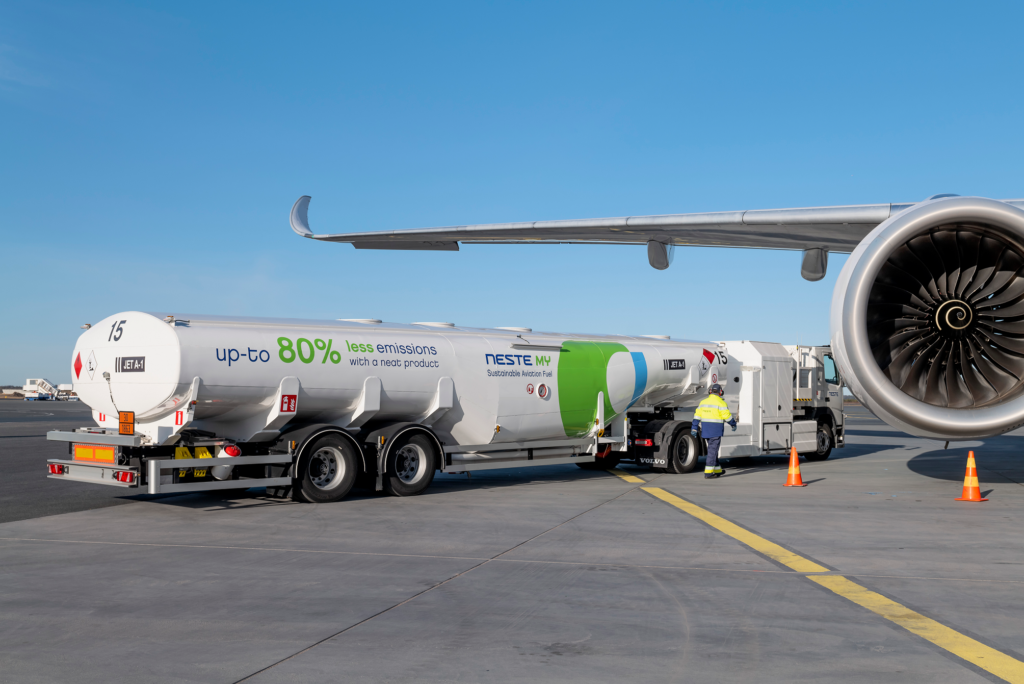
More and more private jet companies are committing to the use of SAF, an aviation fuel produced from sustainable and renewable resources like plants, used cooking oil, and even household wastes. It is similar to traditional fossil jet fuel in both physical and chemical properties, so it can even be mixed with regular jet fuel without the need to modify or change the engines.
According to IATA, using SAF can significantly and directly reduce the life-cycle emissions of carbon dioxide by up to 80 percent. Europe-based International Airlines Group (IAG) and member airlines of the OneWorld Alliance (which include Hong Kong’s flag carrier, Cathay Pacific) have pledged to increase the share of SAF to up to 10 percent of their flights by 2030.
UK-based on-demand private jet company Fly Victor has recently entered a partnership with Finnish SAF supplier Neste, which allows members to purchase sustainable aviation fuel for every private jet booking in a “pay here, use there” manner. When booking a charter, Fly Victor’s private and corporate members can choose how much fossil fuel they want to replace with Neste MY SAF from as little as five percent up to 100 percent.
However, the Fly Victor member will not charter using the Neste MY SAF they have purchased for their own flight. Instead, Neste will deliver their purchased SAF to its partner airline to ensure another in-sector partner flight benefits from a carbon emission reduction by the amount purchased, after the Fly Victor member’s private flight has fully flown.
Funding projects that help reduce emissions
Funding sustainable projects is another viable approach for private jet companies to offset their carbon footprint. Purchasing verified carbon credits that support environmental projects such as forestry, renewable energy, and waste to energy, with a primary objective to help reduce emissions, is one method. Some private jet companies encourage customers who fly with them to pay a little extra to support their carbon offsetting schemes, so passengers can also compensate for their own carbon emissions caused by private air travel.
American private jet company Flexjet is working with aviation sustainability company 4Air, which has developed the first and only rating system with a focus on comprehensive sustainability in private aviation. Via 4Air, Flexjet purchases verified carbon credits that will fund solar, wind, and other projects to offset the emissions from its flight activities, at no additional expense to its customers.
Projects that Flexjet has funded include the India solar energy project, the Alkumru hydroelectricity and Usak wind farm project in Turkey, and projects related to forest management in the US. Just two years ago, Flexjet announced that it had achieved carbon-neutral flight operations by offsetting all of its carbon dioxide emissions with the verified carbon offset credits it had purchased.
Leveraging technology to improve fleet management

In private aviation, there are flights called “empty legs,” also known as repositioning flights or ferry flights, often flown without passengers onboard because the plane needs to be delivered to a charter customer, return to its homebase (if the customer has only booked a one-way charter flight), or move to another base for maintenance, repair, or operations. These flights do not generate any revenue for the company and create inefficiencies. Another major drawback, from an environmental perspective, is that they emit more carbon into the atmosphere, which can be prevented through better fleet management.
Understandably, private jet companies are thinking of ways to reduce these empty legs. Huge discounts on ferry flights, sometimes up to 75 percent, are made available. Some companies are using technologies to improve their fleet management to reduce these flights, thus contributing to the reduction in fuel consumption and carbon emission, as an alternative way to stay sustainable.
Luxury private jet company VistaJet commits to carbon neutrality across its entire business by 2025. One of the sustainable measures it is taking is investing in AI technology and machine learning to work on predictive route algorithms, which can minimise ferry flights. The company uses an advanced flight management system by Flightkeys to optimise its flight route, altitude, and speed, leading to a reduction of nearly 10 percent in fuel consumption.
Its sister company XO also leverages predictive analytics to develop a “floating fleet” management model in which each leg is efficiently managed from both the location and occupancy perspective, resulting in a reduction of occasions when aircrafts fly empty from 50 to 25 percent. What’s more, XO also offers passengers the option to book a charter and sell unused seats back to the company via its own platform, which not only improves seating efficiency, but also translates into potential savings of around 36,000 tons of carbon dioxide.
Developing low- and zero-emissions aircraft
While a number of private jet companies have started to power their aircraft with SAF, electric aircrafts that are expected to cut carbon emissions to zero and create a quiet flight experience are also on the way.
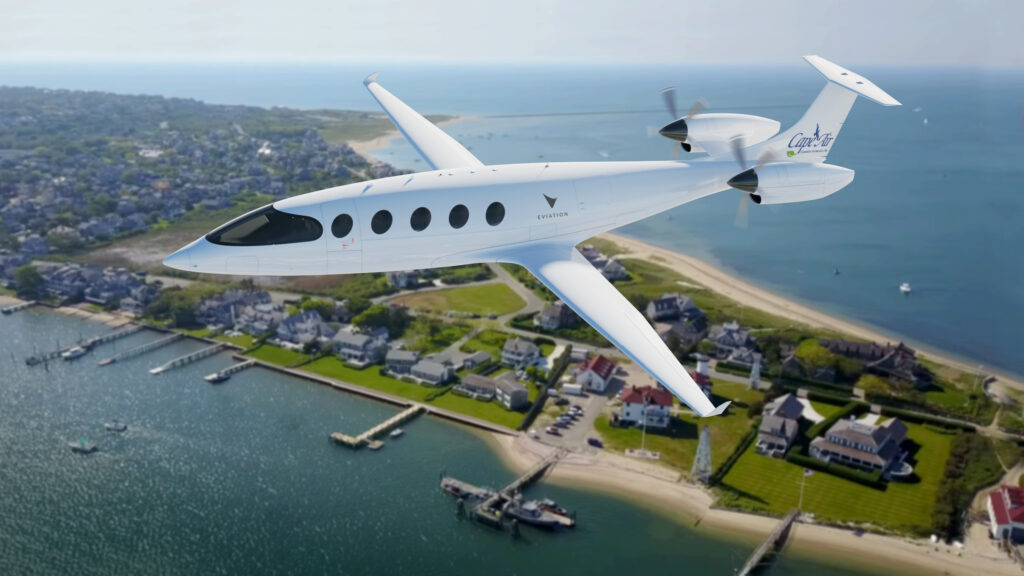
“Alice” is an electric aircraft concept developed by the Israeli-American company Eviation, designed to accommodate nine passengers plus two crew members. Powered by two electric motors, Alice has a maximum cruise speed of 250 knots (463 kilometres per hour) with a maximum range of 440 nautical miles (815 kilometres). The aircraft can be configured for three different purposes: commuter, executive, and cargo. Cape Air has already signed a deal with Eviation to purchase 75 all-electric Alice Commuter aircraft.
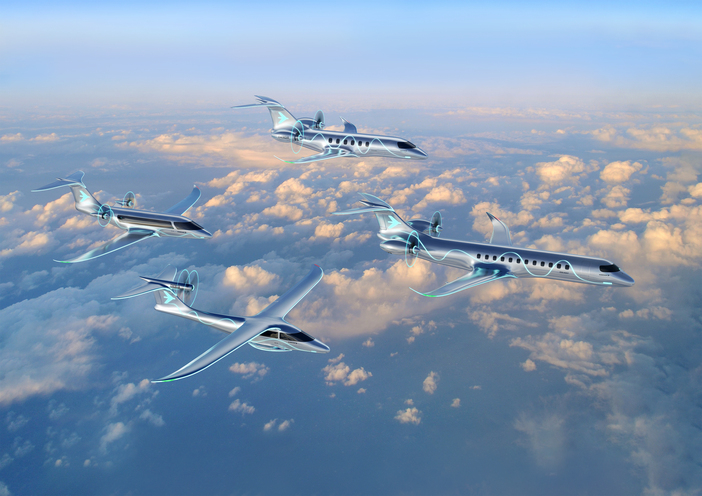
Meanwhile, Brazilian jet manufacturer Embraer seems to be more ambitious with its new Energia family. Unveiled in 2021, Energia is made up of four alternative-fuel aircraft concepts incorporating different propulsion technologies that can reduce carbon emissions to a low level or even zero. The family includes the Energia Hybrid powered by a hybrid-propulsion system that will be able to reduce carbon dioxide emissions by 90 percent with SAF, the full-electric Energia Electric, the Energia H2 2Fuel Cell, and the Energia H2 2Gas Turbine featuring a dual-fuel system with two different fuel sources—SAF or hydrogen.
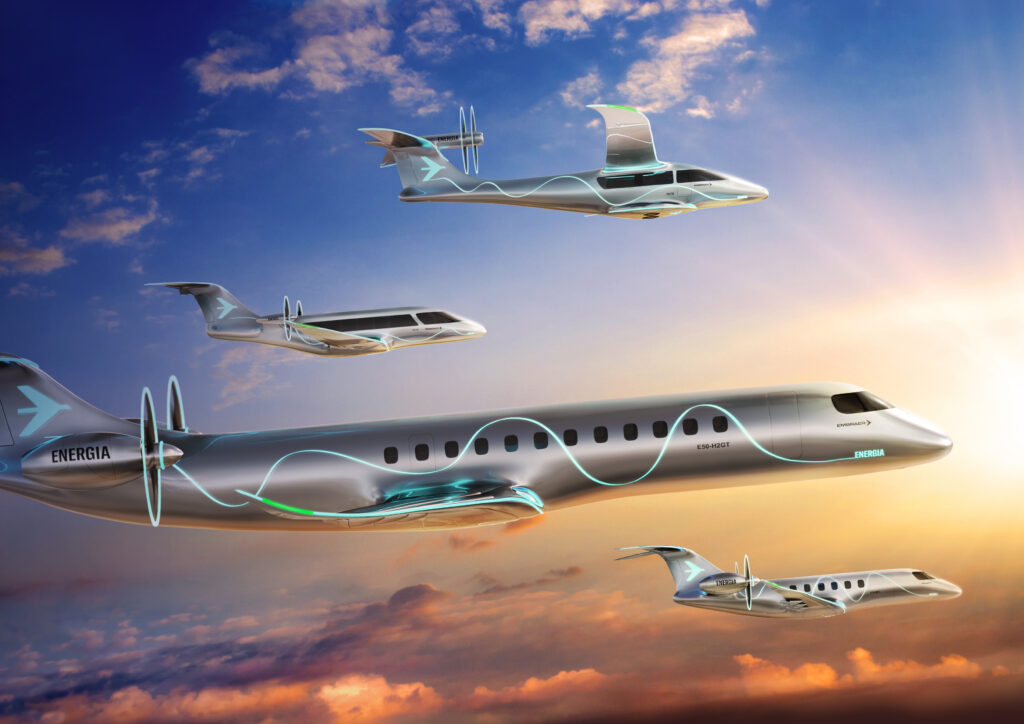
Although we may need to wait until the next decade—between 2030 and 2040—to see these aircraft enter service, an electric vertical take-off and landing aircraft (eVTOL) developed by Embraer’s spinoff company Eve is also poised to enter service at an early date of 2026. In fact, the company is already targeting to have all its aircraft SAF-compatible by 2030.